
MSSJ Research · Evidence before fluency

Research reports for local governments,
with every key claim checked before release.

AI and people write these reports together. A sentence that reads well is not a reason to trust it. The original source, the calculation, the stated limits, an opposing review and a final check decide what we publish.

2

Research reports we started at our own cost

100%

Share of key public claims that go through the control process

0

Unverified claims turned into confirmed facts automatically

The 100% figure does not promise that every fact is correct or that there are no errors. It means we leave no key public claim out of the control process.

Why we pay for it ourselves

We fund this research ourselves, without a contract.

MSSJ paid for Research Reports 1 and 2. We did not wait for an outside contract. For fire safety at wooden national heritage sites and the AI gap in northern North Gyeongsang Province, research that starts only after an accident or a new budget may come too late.

We use this money to collect public materials and to separate what is confirmed from what is still unknown. The result is a baseline that local governments and local organizations can use to start their next decision. This does not mean the public benefit is already proven. It is our public position that we will build the starting point for testing that benefit ourselves.

Research reports

Two reports, two questions

We do not overstate technology. We write down what to check before adopting it, and which warning signs a region should not miss.

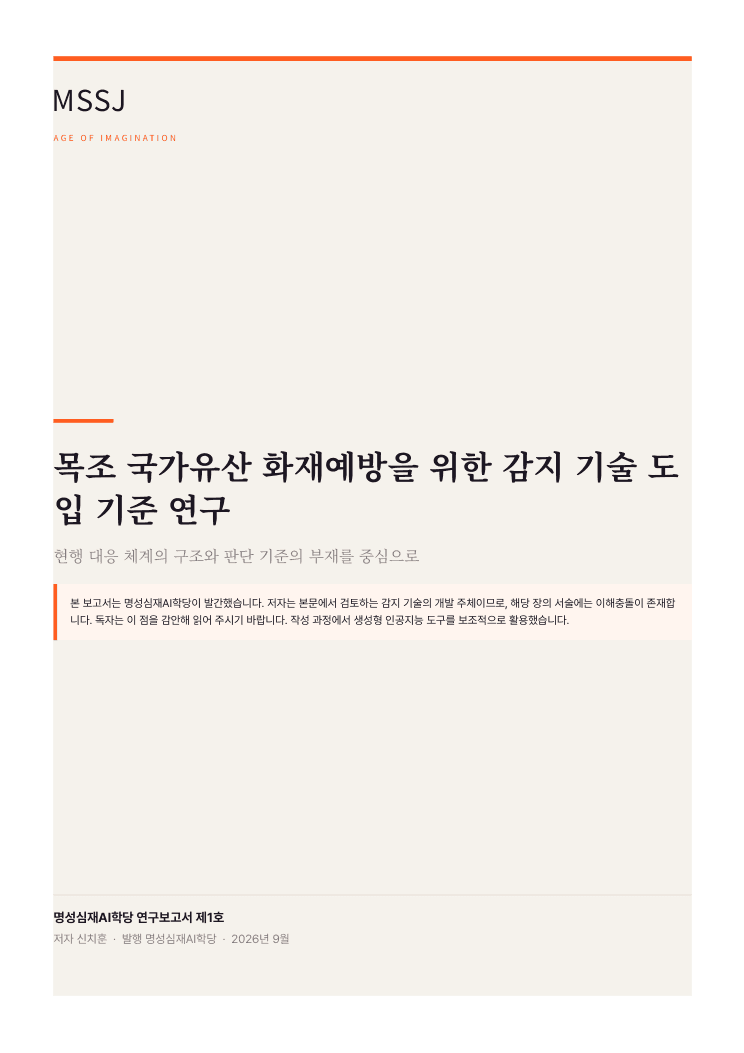
Cover of Research Report 1: criteria for adopting fire detection technology at wooden national heritage sites

RESEARCH REPORT 01

EPUB3 public edition · scheduled for September 1, 2026

Criteria for Adopting Detection Technology to Prevent Fire at Wooden National Heritage Sites

Focus: the current response system and the missing decision criteria · Author: Chihoon Shin · ISBN 979-11-220939-0-2

The report asks what you should check when you review a detection technology. It compares public policy documents with Korean and international standards. It then proposes a common decision process for adoption. It does not claim that any product is better than another.

  1. 01What it detects: flame, smoke, temperature
  2. 02How fast it alerts: detection, decision, notice, arrival
  3. 03How often it is wrong: false-alarm limits and checking steps
  4. 04How far it has been tested: night, rain, fog, backlight
  5. 05Who runs it: duty for alerts, inspection and updates

What this report did not do

We did not do site inspections, performance tests, cost-benefit analysis, product-by-product comparison, or independent checks of public benchmarks.

This is the EPUB3 edition scheduled for publication. It includes the ISBN and has passed EPUBCheck 5.3.0 (a standard checker for EPUB files).
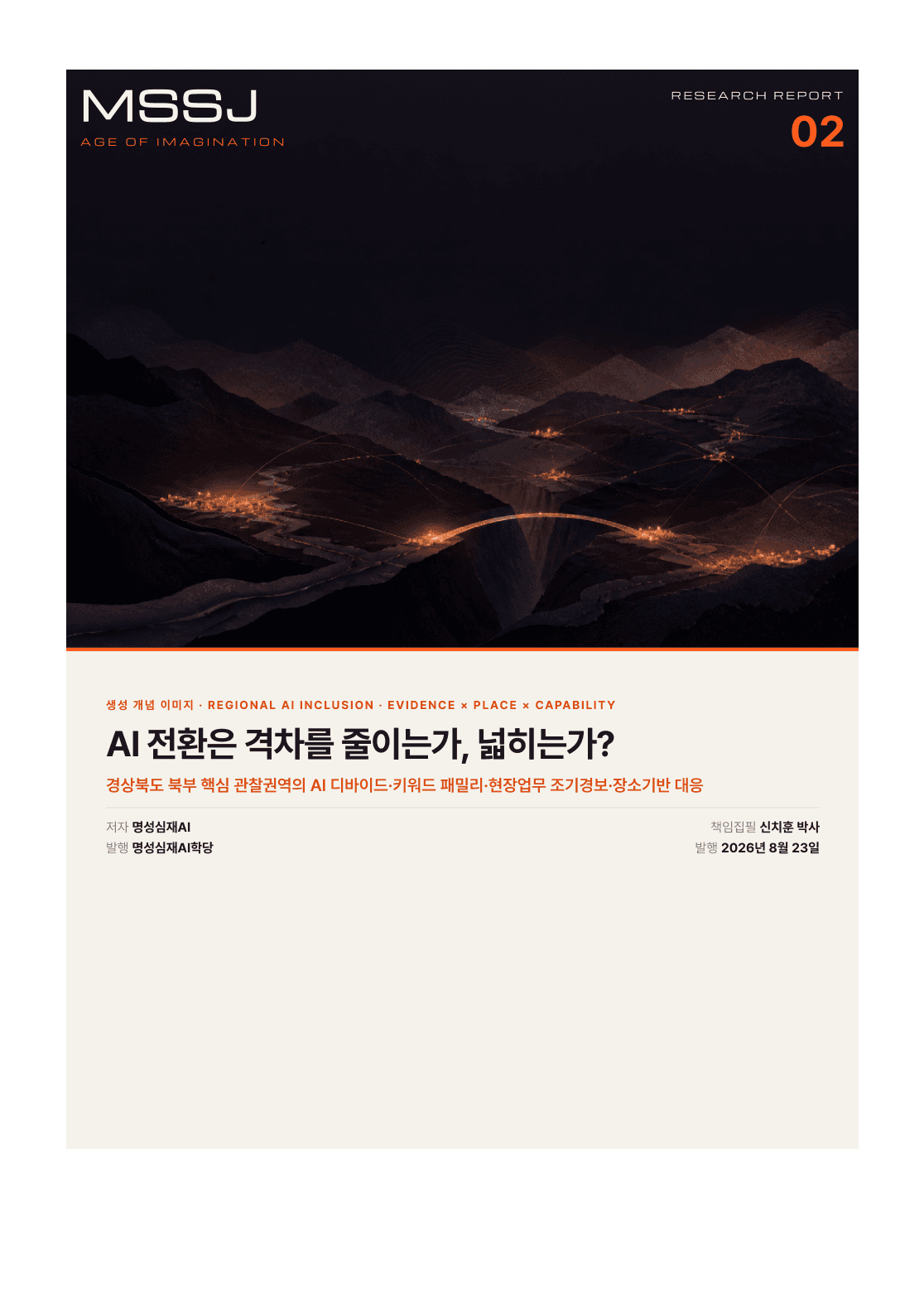
Cover of Research Report 2: the AI divide in northern North Gyeongsang Province

RESEARCH REPORT 02

Public edition with ISBN · v2.0.2

Does AI Transformation Narrow or Widen the Gap?

The AI divide in the core observation area of northern North Gyeongsang Province · PDF, 81 pages · ISBN 979-11-220939-1-9

The report treats the AI divide as more than access. It also looks at gaps in use, in results and in organizational capacity. It links three tools: keyword families, an early warning for field-work fatigue, and a task-performance ladder. The real gap at each institution and the effect of any intervention remain unmeasured.

Checked

Document and structure checks

Published

The designated PDF edition

Not yet measured

Field gaps and intervention effects

Publication does not mean that independent reviews of facts, methods, privacy, rights or publishing are complete.

Evidence control · how we handle AI errors and plausible mistakes

How a draft becomes a published sentence

Automation writes drafts quickly. We do not claim that AI errors (hallucinations) are zero. Every key public claim goes through the same process. A sentence with no repeatable evidence and no authoritative source is not published as a confirmed fact.

  1. 01

    Register claims first

    We split key numbers, statuses and interpretations into single sentences. For each one we record what we can say and what we cannot say yet.

  2. 02

    We check sources and recalculate

    We compare quotes, dates and numbers with the original source. Where possible, we recalculate formulas, page counts and file structure with fixed rules.

  3. 03

    We keep the unknowns in the result

    We do not delete what is unmeasured, unverified or outside the sample. Limits go in the main text, where readers can use them to judge.

  4. 04

    We try to break it from the other side

    We review logic, evidence and possible operating failures one by one. We make a small fix only when the same defect appears again or an authoritative source confirms it.

  5. 05

    If it fails the final check, we do not publish

    We lock file hashes, the file list, verification logs and the publication limits. Finished generation alone is never called complete or approved.

A completion certificate means the work passed checks for missing files, paths, hashes, records and fixed-rule tests. It does not replace review of meaning and quality, business approval, or legal, privacy or publishing approval.

Bring a field question you want to check

We work with you to decide what to check and where to stop.

Contact us about research or field checks